This is a guest post written by Dr Rachel Lehner-Mear. She has recently published a book reporting her doctoral research on mothers and primary school homework.

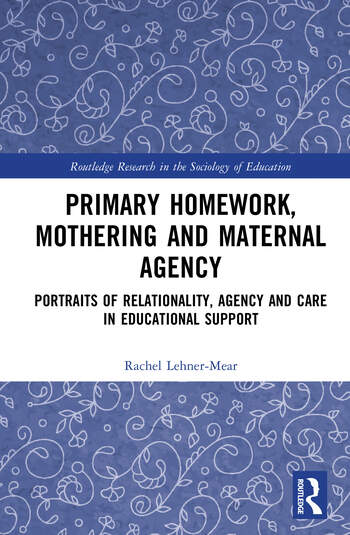
There’s nothing quite like holding your first book in your hands. The tactile nature of the object somehow emblemises the years of hard work. It has weight. Physically turning each page feels satisfying. Black symbols on bright white paper stand as a beacon of hard-earned knowledge. If the Great Gatsby novel emblemised the jazz age, in a small way this monograph gratifyingly symbolised my doctoral and postdoctoral work on mothers and primary homework – the reading, thinking, analysis and writing.
Why turn my thesis into a monograph?
Not everyone turns their thesis into a monograph, but from early on I knew I wanted to. The seed was planted during my reading of the literature, when I made a shift in the focus of my topic – orienting away from researching primary school homework as a purely educational exercise, to concentrating on the people who take part.
The next big moment happened during data collection. Not only did this completely change how I would conceptualise homework, by firmly positioning it as a social interaction, it also thrust real participants to the fore. A kind of ‘loyalty’ to these individuals framed the rest of my research, aligning with much feminist writing on the reciprocity of ethical research relationships, and I became determined to represent them in a future book.
When I was then introduced to the social science portraiture methodology, the framework underpinning my future book-writing was set. Portraiture provided a coherent approach during my doctorate, and afforded the structure for honouring my participants later in the monograph. Conscious that some theses function better as a series of papers, when one of my supervisors commented, ‘But that’s for the book isn’t it?’, the plausibility of my intention was confirmed. This shored up my desire to turn my doctoral work into a monograph.
It’s important to say I was not a PhD candidate who tired of their research topic or data. That ongoing appeal probably sustained me through the work of book-writing.
The book proposal
I did not realise how long it takes to develop a really strong book proposal. I was fortunate to receive a postdoctoral fellowship that afforded the luxury of time to focus on both preparing for and then writing my monograph. Reading other book proposals was helpful, but the process of planning, writing, reconstructing, and refining my proposal was considerable.
Though time-consuming, there was value in undertaking this stage slowly. Each redraft enabled reflection on the multiple ways the ideas from my thesis could be moulded into a book. A good proposal is not just the key to a book contract, for me it was an important developmental process which took me from thesis to successful monograph. It was the deliberate thinking and rethinking I needed.
Finding the book’s purpose
One of the things the proposal forced me to consider was why my thesis warranted turning into a book. No publisher, after all, was going to give me a contract just because years earlier I’d made an internal promise to myself! A monograph needs a distinct purpose. And that purpose is different to that of a thesis.
In the thesis I demonstrated my grasp of the literature, showed I could plan and deliver a logical research design, and learnt (and displayed) a set of research skills. In the follow-on monograph, the research itself became the focus. No longer required to persuade an examiner that my work met the standard expected of a PhD, the balance altered and the contribution of the argument within the project took precedence. This shift, I found, allowed that argument to bloom in ways I hadn’t before contemplated.
Restructuring
I now wanted to tell a slightly different story and that needed an alternative structure. Restructuring was not the simple process often spoken about – cut your methods chapter and update the literature. Elements of my original text were cut, synthesised, or re-sited, and almost all were rewritten to a greater or lesser extent.
No longer used as an illustration of my topic knowledge, I repurposed my literature review across the book, weaving it into the empirical sections to provide a series of targeted lenses through which each chapter could be ‘viewed’. The same could have been done with my key concepts, however instead I created a second ‘introduction’ chapter setting out the theoretical and conceptual tools needed to understand the work.
In reorganising how I presented and used the data itself, I found myself creating a new structure for my argument. This shift resulted in a change in emphasis – where previously constructs of emotion ‘led’ my data, now the notions of relationality, agency and care became the dominant ideas. This does not mean I rejected the conceptual tools of my thesis, simply that I used a different dynamic to articulate the story.
Other changes
Changes in how I presented my argument were augmented by other alterations – not least, by decisions around what should be in/excluded from the book. Unlike exclusions from the thesis which felt like a loss, this time I identified aspects of the work that could be disseminated differently. One whole thesis chapter, for example, was rewritten as a standalone journal article. In contrast, some participants who had previously been pushed to the periphery of the thesis, due to lack of space, were written back in as new portraits with their own narrative.
I also conducted some additional research specifically for the monograph. This intentionally broadened the data set and included dimensions (and participant types) not covered by my original recruitment. More analysis added depth and breadth to the argument I wanted to make.
Most changes remain rooted in work which appears in my original thesis. However, both introduction and conclusion needed to be completely different. While small elements of the thesis introduction are still visible, the book’s introductory chapter initially expands away from the academic world to offer a society level, even global, framing for my argument, highlighting to the reader why this book is worthy of their time.
In creating a different kind of introduction, the stylistic changes required for the monograph are made clear from the outset. I found this stylistic repositioning ‘freeing’ – talking directly to the reader aligned with the kind of book I wanted to write and permitted me both an authorial and authoritative tone. I enjoyed creating the introduction chapter. Writing it late in the process meant it spilled easily onto the page, framing the argument, demonstrating my confidence in the work and underlining the point I’d reached as author of this book.
Just as the introduction is entirely new, so is the conclusion. The changes made and contrasting purpose between thesis and book conclusions called for original writing – not an appeal to be accepted into the academy, but, by reflecting across the work, a final, authorial claim about how this topic should now be understood.
Looking back
Valued others were integral to this journey. A mentor with whom I could springboard the new ideas, repositioning work and structural changes was highly beneficial. This was important throughout the months of both proposal development and (re)writing because lone authoring through substantial developments can be tough.
My feelings at the end of this process are also worth mentioning. The PhD was a long road that changed me as a researcher and a human. However, comparing my thesis with the final monograph, I recognise another substantial shift. I was pleased with my thesis, but I’m delighted with the book. Where, once, pride oriented around surviving the mammoth doctoral journey, now a more subtle and targeted pleasure arises from seeing the book I have created. Because now I notice improvements to the original work – and this recognition sustains my future development as a researcher.


Thanks for this terrific post Rachel.
I will save it as a PDF to forward to doctoral researchers who want to discuss with me the options for publishing their PhD as a monograph.
In the past I have found it difficult to persuade individuals that publishing the thesis as a monograph requires significant work and a different approach.
Your post has provided an excellent insight into how different a “beast” the successful monograph is.
Thank you.
Sara
LikeLike