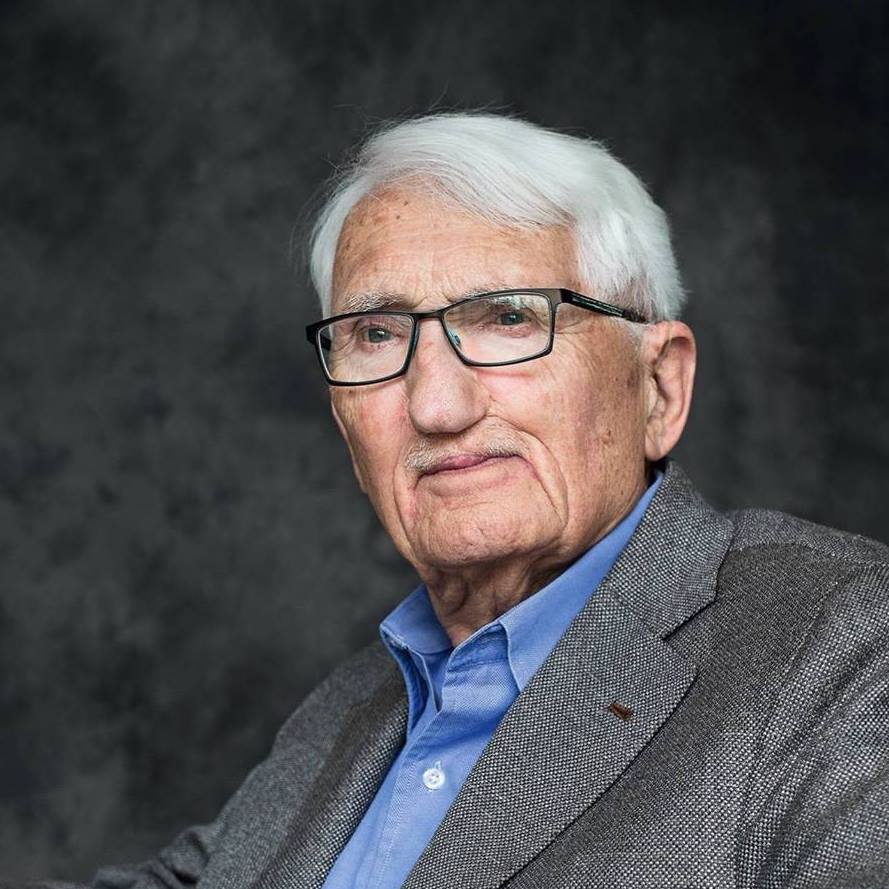
Jürgen Habermas died on Saturday 14 March, 2026 in Starnberg, near Munich. He was 96. The news has been moving through academic social media in the way these things do, with people sharing half-remembered seminars and dog-eared copies of books that changed how they thought.
Let me situate Habermas for those of you who havent come across him – Habermasian scholars look away now, this is a very abbreviated and partial account!
Habermas was the last surviving member of the Frankfurt School’s second generation, a student of Adorno, and for decades one of the most widely read social theorists in the world. His work addressed democracy, law, and the conditions under which rational public life is possible. In a moment when those conditions are visibly contested and fragile, his death feels like more than just a biographical event.
Habermas’s interest in communication was both philosophical and political. His early work on the public sphere traced the historical emergence of a space between the state and private life where citizens could come together to debate matters of common concern. That space had genuine democratic potential, he said, because it operated, at least in principle, on the force of argument rather than the force of authority. You could not win a public debate simply by being powerful, Habermas said; you had to give reasons, and those reasons had to be ones that others could assess and contest. The obvious counterargument is that the public sphere Habermas described was always exclusionary, bourgeois, male, Western, propertied, not mediatized – no X or Fox news here! Habermas did acknowledge the limitation of his analysis to some extent in later work. But his point was that the idea of a public sphere contained a normative standard against which existing arrangements could be judged and found wanting.
This was important for what Habermas called discourse ethics. Genuine democratic communicative exchange, for Habermas, meant that participants treat each other as equals: each person can raise claims, question the claims of others, and expect their contributions to be taken seriously. Power, status and institutional position are supposed to be bracketed. What carries weight is the quality of the reasoning. He called this the ideal speech situation, a regulative ideal implicit in the very act of making a claim on someone else’s understanding. Every time you assert something and expect another person to engage with it, you are already committed to a set of norms about reciprocity and equal standing, whether you acknowledge them or not. The democratic force of his communication theory lies in the observation that ordinary language use carries within it a logic that runs counter to domination. However, Habermas’s central argument is that modern societies tend to what he calls the colonisation of the lifeworld by system logic, the displacement of communicative reason by efficiency, targets and administrative procedure.
For academic writers, two ideas from Habermas’ work are worth sitting with.
The first is communicative action. Habermas distinguished between using language to secure a predetermined outcome and being open to where an exchange might lead. He called the first strategic action and the second communicative action. Most academic writing sits somewhere between the two, but a lot of doctoral advice and training pushes it toward the strategic end. You learn to position your argument against the field, to anticipate objections and close them down, to signal where you stand. All of that is real and necessary. But Habermas’ distinction invites a harder question: when you write, are you open to being changed by the encounter with the reader? Are you genuinely ready for the reader’s response? Is the argument available for inspection, or does it perform rigour while foreclosing its conclusions? That question sits a little uncomfortably with much of what peer reviewers and journals seem to want, which is part of why the question is worth asking.
The second Habermasian idea worth thinking about is his account of validity claims. His argument was that any serious speech act implicitly makes three claims at once: that what is being said is true, that the speaker is sincere, and that the utterance is appropriate to the context. Academic writers are trained almost exclusively about the first. The other two get much less attention, but readers respond to all three. When a piece of writing fails to convince despite its technical competence, the problem is often not in the evidence but in how the writer sounds. Do they seem guarded, self-serving, performing an authority that sits oddly with the material? If this just a clever argument lacking in integrity? Or does the writer seem ready and willing to engage in discussion? Readers pick up being clever for clever’s sake even when they cannot name it. Treating honesty, values and integrity as scholarly concerns can give academic writers a handle on why some arguments land and others do not.
But you don’t need to have read Habermas to use what he offers. At its most practical, his work reframes writing as a relationship. The reader is not an obstacle to be managed but a participant in a conversation. Whether your argument genuinely invites that reader participation is a question worth returning to every time you revise. And politically, Habermas points us towards the importance of working for equitable reciprocal relationships in – and beyond – writing.
 patter