

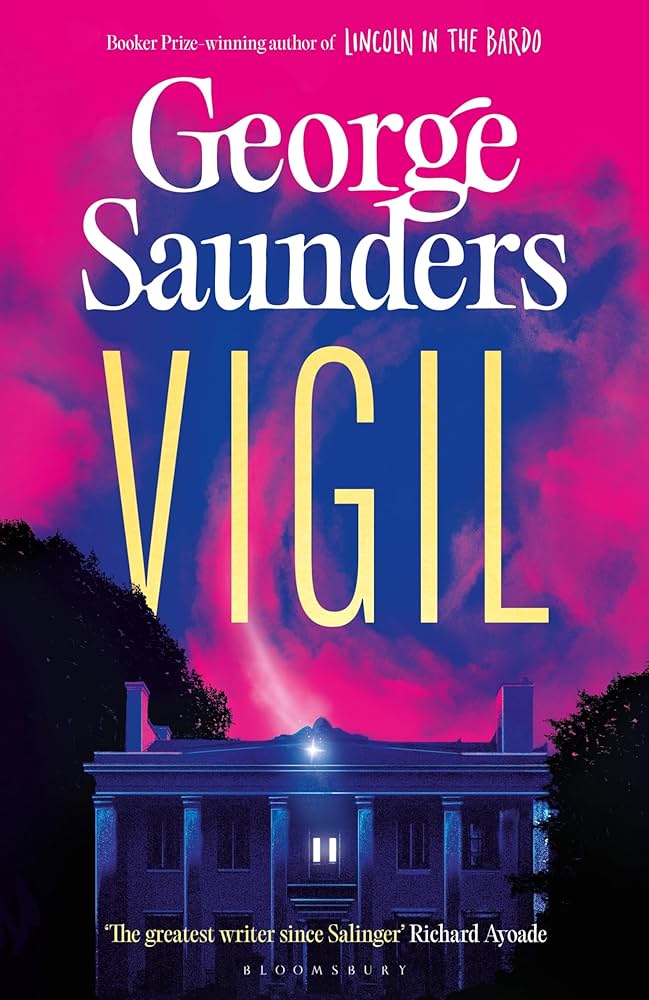
George Saunders won the Man Booker prize in 2017 with his novel Lincoln in the Bardo. Earlier that year he wrote about his revising process.
My method is: I imagine a meter mounted in my forehead, with “P” on this side (“Positive”) and “N” on this side (“Negative”). I try to read what I’ve written uninflectedly, the way a first-time reader might (“without hope and without despair”). Where’s the needle? Accept the result without whining. Then edit, so as to move the needle into the “P” zone. Enact a repetitive, obsessive, iterative application of preference: watch the needle, adjust the prose, watch the needle, adjust the prose (rinse, lather, repeat), through (sometimes) hundreds of drafts. Like a cruise ship slowly turning, the story will start to alter course via those thousands of incremental adjustments.
The artist, in this model, is like the optometrist, always asking: Is it better like this? Or like this?
The interesting thing, in my experience, is that the result of this laborious and slightly obsessive process is a story that is better than I am in “real life” – funnier, kinder, less full of crap, more empathetic, with a clearer sense of virtue, both wiser and more entertaining.
And what a pleasure that is; to be, on the page, less of a dope than usual.
Revision, Saunders says, is The Work. It is the writing. Revising isn’t a final polish once the real writing is done, not a tidy-up before submission. You know, you write something, you read it, you make it better, then you go again. And, he implies, there is no moment when the draft signals it has had enough. You have to decide when enough is enough.
Doctoral researchers are not necessarily taught to think about revision this way. Many treat a draft as a rough version of what they will eventually submit, a sketch that needs tidying up rather than a text to be repeatedly worked over. Going through something many times, making fractional adjustments on each pass, sounds pretty inefficient. And yet Saunders, who has spent decades attending to sentences, treats it as entirely ordinary.
The second thing Saunders does is stop thinking about himself. The reader becomes the only concern. His phrase for the state he tries to reach is “without hope and without despair,” ( he borrowed that from Chekhov). This means reading the text for what it actually is rather than what he feared or wished he’d written. And this means suspending his own investment in the argument and attending instead to what a first-time reader will actually see on the page.
Doctoral researchers can find the switch to thinking about the reader difficult, for reasons that make complete sense. Living with an argument for months or years, knowing the literature inside-out, seeing how all the pieces connect, all of that knowledge gets in the way of you reading your own prose with a critical eye. The reader in your head already knows what you know, supplies the links you’ve left out, follows logic that you haven’t actually spelled out.
Letting a draft sit helps. So does an alt. reader who doesn’t share your expertise, because they read what is actually on the page rather than what you intended.
Getting the distances Saunders recommends requires an attitude shift. Saunders says his process is like that used by an optometrist. When you are sitting staring at the letters on the wall chart the optometrist gives you a choice of lens and asks you, “Is it better like this? Or like this?” They’re the questions to ask in revising. The judgement is always comparative. Your decision is not whether the text is good in an absolute sense, but whether this version is better than that one. And in particular, is it better for a reader coming to it without your prior knowledge?
The third thing about Saunders’ process is that it requires trying things and abandoning them. Make an adjustment, check the needle, keep it or undo it, move on. Many adjustments will do nothing. They won’t move the needle. That’s not a problem, Saunders says, it’s how this kind of testing out process works. No single change is decisive. Improvement is cumulative.
There’s an important message here for doctoral researchers working to deadlines. Revision takes longer than most people allow for. Time is spent on drafting, and revision gets whatever hours are left before the due date, which is often not many. The result is a text where the decision-needle is still somewhere in the middle of the dial. The answer is to finish drafts earlier than feels necessary. Submitting a chapter to your supervisor two weeks before the deadline rather than the night before is a good idea. Let it sit, read it cold and make dozens of small adjustments instead of one panicked midnight pass through the text. Earlier isn’t just better in principle; it changes the kind of revision you can do.
The final thing is that, after all that revising work, the text that comes out is pretty much guaranteed to be better. For Saunders this means funnier, kinder, more empathetic, less full of crap. “What a pleasure,” Saunders writes, “to be, on the page, less of a dope than usual.” For an academic writer, revising means a text that is more authoritative, persuasive, well reasoned, elegant, interesting. And yes, the academic writer also seems like less of a dope.
So Saunders’ lesson is this. Trust your revising process, give it enough time, and it will take you somewhere you couldn’t imagine or see from that first draft.


so helpful. Am right at this stage
LikeLike
Thank you! I enjoy all of your posts but this one is particularly good! Perhaps because I’m close to finishing the first draft of an academic textbook, and your post makes me rethink how I approach the revision process. So good!!
LikeLike